Showing posts with label Review. Show all posts

Monday, October 26, 2020

Paranoia Agent (2005) Review- Why This Satoshi Kon Anime still Resonates 15 Years Later.

Warning: This review contains spoilers for the events of Paranoia Agent. It contains content and subject matter not suitable for younger audiences. Read at your own risk.


"The whole world is about to end because of a goddamn puppy."

These words are among many that are a part of a series that has become another cult classic of sorts in the works of the late Satoshi Kon. While met with mixed reception upon its initial airing in 2005; it gained a devoted following in the vein of his theatrical films, and has since undergone a re-evaluation that places it among Kon's best works. I've been experimenting a lot given the circumstances this year; and with that in mind, this review is one that will be perfect for the time. So, to explore why this anime still resonates 15 years later; let's open up "Paranoia Agent."


From the opening sequence alone, it's clear that nothing will be as it seems; and while the images and characters shown might be random at first, as the series goes on, each one has a purpose in the story. The anime follows a mystery centered around an assailant known as "Lil' Slugger," a young man who attacks people with a bent baseball bat; identified by his small stature and golden rollerblades. The first episode is appropriately enough, titled "Enter Lil' Slugger."

The story wastes no time in establishing itself, following the creator of a new anime series known as "Mellow Maromi," named Tsukiko Sagi. She is one of the many key figures of the story; and ends up being the first target of Lil' Slugger. It has been noted that Sagi is a sort of older subversion of Ayumu "Osaka" Kasuga of Azumanga Daioh. As someone who enjoyed that anime as well, I like the questions raised by this. What would she be like as an adult with the same eccentricities as she had in high school? What if there was even darker meaning to the now-memetic scene of her half-asleep with the knife? Most of all, what if there is a more troubling undercurrent to the "cute" persona and image?

Sagi's attacks gain the attention of the authorities and the press; both of whom wonder if there's something else behind the attacks, until they too become targets of Lil' Slugger. Sounds familiar, doesn't it? As I shall get into over the course of this review, the title has multiple meanings in the story.

Further proof of this lies in the following episode, "The Golden Shoes." This one centers around a young man named Yuichi Taira, known as "Ichi" for short. He's a student who seems to have it all: popularity, good looks, athletic and academic ability; and a promising future as class president. Unfortunately, there is one issue he's dealing with: a classmate who isn't as bright, pretty or active whose name is Ushiyama Shogo. This is isn't helped further by him being accused of attacking Shogo in connection with Lil' Slugger. His social status takes a dive as a result, with only his mother and his tutor; Chono Harumi still trusting him. He even tries to discard his own gold rollerblades in connection with Lil' Slugger; to no avail: the skates, and Lil' Slugger find their way back to him.

Ichi's attack leads into the events of the next episode, "Double Lips." Though Ichi being attacked does clear his name, it turns out Harumi has her own dark side: an alternate identity as a working girl under the alias "Maria." This is also another one of the major recurring themes of the anime: how Lil' Slugger attacks people in a state of mental duress. Sounds familiar, doesn't it? As I shall continue to elaborate; the very title of this anime is one that has multiple meanings.

As the two personalities clash in more ways than one, Harumi's attack again leads to the next episode, "A Man's Path." This episode focuses on a police officer named Hirukawa Masumi; who has a connection to Harumi's identity of "Maria" the working girl. Like many, his image as a "family man" is not what it seems. In truth, his dealings with her among other working girls get him into trouble with the Yakuza; who don't take kindly to not having their debts paid. Their leader, an "oyabun" named Makabe then makes an example of him by burning his forehead with a cigarette and demanding he work off his debt! Just glad he didn't cross the "Dragon" Kiryu (side note: looking forward to Yakuza Like a Dragon later this year, should be cool).

Amid all his "side work" with the Yakuza, Lil' Slugger attacks Masumi; but since Masumi isn't knocked out; he's able to bring him in, leading to the next episode, "The Holy Warrior." The suspect of Lil' Slugger is Kozuka Makoto, a student in 8th grade who fancies himself as a knight of his favorite fantasy RPGs. Given his demeanor towards the detectives interrogating him; his train of thought is at its core quite simple: He's really not that different than everyone who was giving the developers such a hard time over The Last of Us Part II.

Makoto being pegged as a suspect for everyone but Tsukiko leads into the next episode; "Fear of a Direct Hit." The episode takes place during a typhoon; and the title, much like others in the series has multiple meanings; one of which being related to the storm. After Tsukiko is questioned by the authorities, the episode also deals with a teenage runaway named Taeko; who is Hirukawa's daughter. They're not on the best terms, especially given the reason she ran away: Having inappropriate videos taken of her without her knowledge.

Taeko is attacked by Lil' Slugger, which leads us into the next episode, simply called "MHz." As more victims are targeted, the authorities continue to question Makoto; to no avail. There's even the speculation that there may be more than one assailant, which isn't entirely accurate; but still not without any impact on the story. Makoto is then found dead in his holding cell; but it's not the end for Lil' Slugger.

Now, the story comes to a point where things really go off the rails: "Happy Family Planning." On top of the title not being shown till the end, on a prophylactic dispenser no less; the main plot revolves around a suicide pact between three people only known by their online screen names: an old man named "Fuyubachi," a young man named "Zebra" and a young girl named "Kamome." The episode is a mixture of genres, blending dark comedy; drama and psychological horror in the span of 30 minutes. One of their attempts even had to be edited for the UK airing of the episode, with their hanging cutting a total of 80 seconds of footage. Their pilgrimage takes them to a bath house; which leads them to a chance encounter with Lil' Slugger!  Adding to the atmosphere of this episode is the fact that it's never explicitly made clear whether their attempts were successful: their lack of shadows in a photograph is one of the only implications; and it's more or less up to the viewer to interpret their fate. I've always had a soft spot for those kind of endings.

Next up is "ETC," which revolves around four housewives telling their own stories about Lil' Slugger. This kind of storytelling is another kind of narrative that has been passed down for ages; with the concept of the unreliable narrator  and "Rashomon" style in particular being used to great effect here. One of their stores tells of a student overworked to the point of vomiting up his math problems like that horrible "Sick" PSA. Another tells of a young married woman with a mother-in-law who badgers her in a passive-aggressive fashion until she's attacked. The third is a rather unsettling ultrasound, and the last turns out to be a script editor who's the last of several major focal points in increasingly insane stories. The title card is the last shot from the roof of their apartments; but now things are really getting crazy.


Further compounding how Lil' Slugger impacts the story on multiple levels is the episode "Mellow Maromi," centered around the production of the in-universe anime of the same name. While not the most lighthearted production; it overall presents a harrowing contrast between the cute puppy dog that's the subject matter of the anime and the members of the production team all being mysteriously killed one by one. Eventually, only the production coordinator Saruta Naoyuki remains; and while he does get the master tapes of the finished anime to the network; he too is claimed by Lil' Slugger. I still have three more episodes to go over in this review, but for now; it's one of many that makes the lyrics to Eminem's "Stan" make sense, especially given the meaning of that term nowadays as shorthand for obsessive fans.

The denouement of the series starts to take hold in the episode "No Entry." Ikari is now just a security guard; and his wife Misae is growing increasingly disenchanted with him. Yet, she won't give in even with Lil' Slugger in her midst; even as Ikari becomes a laborer. Ikari laments that he just wanted to go after common thieves; not get wrapped up in Lil' Slugger's mind games. 

As Ikari is given his simple world, the second to last episode sees the emergence of a new persona: "Radar Man." Maniwa is told to "dance with the rabbit" in the dying words of an old man; taking up the mantle of Radar Man to not just confront his former colleague; but to get to the truth about Lil' Slugger. As it turns out, their conflict leads to a startling realization before the end: Lil' Slugger and Maromi are one and the same! ... Before I finish this, that's one of the most fascinating reveals I've ever seen; as someone who has examined both family-friendly works about video games and a dark post-apocalyptic epic that's one of my favorite films and one of the best of all time.

Now, the conclusion; fittingly titled "The Final Episode." Here, we learn the truth behind all of the events of the series and how they led to this; and why I chose to lead with this line: "The whole world is about to end because of a goddamn puppy." It turns out the true nature of Maromi and its hold on not only Tsukiko; but the entire country stemmed from a real puppy dog Tsukiko had as a child; before the dog was hit by a car, killing it. Rather than let her family know the truth;  she created Lil' Slugger as an assailant to cover it up. As such, it makes a chilling kind of sense as to why Lil' Slugger is the manifestation of everyone else's hardships; and the flip side to Maromi's coin. It's only when Tsukiko finally opens up about what happens to her inner child that the conflict finally ends. The series then closes on a time skip two years after the events of the story; with Ikari having returned to work as a security guard; Tsukiko now working an office and the country having moved onto a new mascot to obsess over. Fifteen years later; that ending has lost none of its relevance. In fact; to lead off my final thoughts in this review; it's actually gotten more relevant as of its recent rerun on Toonami earlier this year.

In a year that has been wracked with a global pandemic; environmental uncertainty and social unrest at home and abroad; the very limits of the human mind have been tested in ways that arguably haven't been experienced in ages. Everyone has found a method of coping; and this has been one of mine. Though in the past, my hobbies have been looked down on by others; now, having the same recreation habits since I was 13 has arguably left me better equipped to deal with all this than others might be.

With that said, the themes and stories presented by "Paranoia Agent" still help it resonate 15 years later. While Satoshi Kon may have sadly succumbed to pancreatic cancer in 2010; this anime is another piece of his legacy. Much like his anime films; this TV series has left an impact in how it blends the simplicity of the everyday with the mindbending and boundless potential of the human psyche. The animation style is also the ideal way of exploring this concept: real enough to make the scenario believable, yet fantastic enough to let the audience know things aren't what they seem. Though much has changed about the world since the series initially aired in 2005; its themes in every aspect from pop culture obsession to the loss of innocence have remained every bit as relevant, if not moreso in the time since its original airing. That is why I'm glad the series has gotten more of the recognition it deserves since it first released. 

I know I have taken a while to get this done, and given the time I'm posting this; I'm glad I've been able to share it with you all. Happy Halloween, and don't forget to vote by next week. That will be all for now. Later.

Tuesday, June 23, 2020

Sonic the Hedgehog (2020) Review

Hello everyone: with the franchise celebrating its 29th anniversary as I type this; allow me to once again say: "and now for something completely different!" Given how this movie is finally seeing a release in the franchise's native Japan (after previously being pushed back due to the novel coronavirus/COVID-19 outbreak), let's open up the live-action "Sonic the Hedgehog!"

On top of the Paramount logo having rings instead of the usual stars (always like how studios play with their vanity plates lately), the Sega logo at the beginning also shows a much larger world of their games in play a la Marvel! I will address this more later, but that’s a neat touch.


After a brief scene “in medias res” showing Sonic (voice of Ben Schwarz, TV’s “Parks and Recreation”) clashing with Dr. Ivo “Robotnik” Eggman (Jim Carrey), we open on a scene of a younger Sonic on his homeworld. Even at a young age, his speed and wit are impeccable; much to the concern of his guardian/mentor, an owl named Longclaw (voice of Donna Jay Fulks). Sonic describes her “if Obi-Wan Kenobi had a beak and ate mice.” Don’t know what’s going to happen with this Disney Plus spinoff, but we’ll see.

The two are then ambushed by a tribe of echidnae, forcing Longclaw to send Sonic into hiding when he’s still a child. Using one of many golden rings, Sonic is able to escape to Earth; but Longclaw ends up captured by the echidnae! While her fate is not entirely clear (nor the true motives of the echidnae), Sonic is left to fend for himself.


We cut to the present day, roughly 10 years later in Green Hills; Montana (I see what they did there), a small town resided over by a police officer named Tom Wachowski (James Marsden, “X-Men” series). He also wants to transfer to San Francisco alongside his veterinarian wife Maddie (Tika Sumpter). I have to wonder: how much did Zillow pay to get into this movie over other real estate brokers?

After rescuing a turtle to Queen’s “Don’t Stop Me Now,” Sonic exposits about his time hiding out; dubbing Tom “Donut Lord”, mentioning the time he’s spent “outside, looking in” while they’re watching “Speed.” More on that later, but I will admit this movie is much better than I was worried about it being as yet another sort of “reverse Isekai” story.


While Sonic is able to hide out, now being closer to his age in most other continuities (15); other townsfolk such as Crazy Carl (Frank C. Turner) are growing suspicious of “The Blue Devil”, and I like the little nod the movie gives to the “Sanic Hedgeman” meme with his sketch. 


On that note, I also love some the Easter eggs in his hideout: including a reference to “Hilltop” on a discarded sign he’s using as a ping-pong table; and the sigil on his headband when he’s practicing with nunchaku.


Most of all, the map of “Safe Worlds” that Longclaw left him is actually based on the original design doc from the first game. He’s not happy about potentially having to go to “Mushroom Hill Zone” should things go south. That’s the first stage from Sonic and Knuckles, and his quip that he hates mushrooms is a subtle dig at his longtime rival Mario. Also, between that and the echidnae that ambushed him; it’s not often we get sequel setup near the beginning of the movie.


Sonic also witnesses a baseball game, deciding to practice himself that night; able to play everyone on the field at the same time! Running around the field, he goes so fast he ends up not only causing a power outage in town; but across the Pacific Northwest, even knocking out a satellite!

This ends up attracting the attention of the Pentagon, causing the military to enlist “Robotnik” and his assistant Agent Stone (Lee Madjoub) to investigate. I must say, that Carrey steals the show here: channeling the same manic energy that made him famous; and adding another great entry to his list of comedic villains such as the Riddler, the Grinch and Count Olaf to name a few.


He sends out a bunch of egg-shaped drones to scope out the area. Tracking Sonic’s footprints, Sonic realizes he’s in trouble and has to leave! He grabs the map and the bag of rings, and I was wondering how they’d work those in. On top of reminding me of the Portal games, they actually were used for transport in more than one continuity. The games’ special stages, for example.

Tom gets a call from Maddie, who’s already met up with in-laws Rachel (Natasha Rothwell) and Jojo (Melody Niemann). He then notices some noise in the tool shed; and goes to get the tranquilizer gun he was going to use on the raccoons, much to his wife’s chagrin.

Now, I must address the elephant in the room: the infamous VFX redesign. Even as someone who didn’t hate the design as much as some others, I agree it was laughable for all the wrong reasons. It recalled memories of both the live-action Super Mario Bros. and 2000s Scooby-Doo movies. I also pointed out a game-accurate design is possible with current CG tech, citing both Disney’s Wreck it-Ralph films and WB’s Ready Player One as proof. Suffice to say, it was a good call on the damage control, and I have more to say later. Again, not the last time they had to redesign CG.

RTX Off VS On


Tom tranqs Sonic, who drops his bag of rings on the Transamerica building’s spire in San Francisco; forming a reluctant alliance to escape. First, Robotnik accosts Tom about Sonic; and Robotnik sends more smaller drones to scope out the house. Again, I love how Carrey portrays the increasing obsession with Sonic as the movie goes on. 

As Sonic super spins down the stairs, Robotnik finds one of Sonic’s quills as Sonic comes out! Tom actually decks Robotnik as Sonic jumps onto the drone; disabling it with a skillet as he and Tom escape in Tom’s truck! Agent Stone meets up with Robotnik, who declares his intent to capture Sonic; also ordering “new frames” after his were damaged in the attack.

Tom is skeptical of Sonic, who tries to get to San Francisco on his own; and promptly lands in the Pacific Ocean. Very subtle way of working in his dislike of water. Apparently, hedgehogs can actually swim, but Yuji Naka thought otherwise. Though there weren’t search engines in 1991, there were these things called encyclopedias listing that fact. Tom grudgingly agrees to help Sonic, who promptly shakes himself dry; giving us the blessed image of “floofy Sonic”.


I really enjoy how Tom is essentially the “straight man” to contrast the more wild Sonic. Given how crazy the series and the world have been in my lifetime alone; making this into a sci-fi road trip buddy comedy makes a weird kind of sense. 

That night, Tom and Sonic stop at a roadhouse diner known as the “Piston Pit,” claiming a disguised Sonic is a 43-year-old. Hey: He doesn’t look a day over 29! Some barflies accost Tom and Sonic, who narrowly escape a bar brawl via a “bullet time” demonstration of his speed. Insert Matrix or Quicksilver reference here.

Tom and Sonic then stop at a motel for the night, and I really like the tongue-in-cheek style of the humor in this film. Jeff Fowler, the director had previously worked with Tim Miller on the first “Deadpool” film; and this kind of plays like a family-friendly version of that.

The next morning, Robtonik is able to trace Tom’s truck just as it crosses the Siskiyou county line; and the border into California! As Tom and Sonic converse, Robotnik sends more drones after them; including one that’s as big as a tank! Sonic then slingshots off the truck and knocks out the drone with his Spin Dash! I honestly don’t have a problem with the dance he does, though I do hear the Crab Rave in my head when I see it.

Robtonik then sends a series of mini-drones after Tom and Sonic; including some on wheels and in the air that resemble the Motobugs and Buzzbombers if they were redesigned by Apple Inc. 

A sticky bomb is narrowly removed from Sonic; but he’s still hurt when he’s caught in the explosion! He’s still alive, but Tom needs to get him to safety before it’s too late! Robotnik then takes a lick of Sonic’s quill as Tom and Sonic make it to San Francisco!

Maddie and Jojo are glad to see Tom, despite Rachel’s objections. As Maddie starts tending to Sonic’s wounds, Robotnik starts examining the quill to music! Nice that his mobile lab also doubles as a nightclub. Agent Stone then comes in with their coffee, leading to another great comedic exchange and the proper introduction of the film’s version of the “Egg Mobile.”

While Sonic is thankfully not injured internally, he does have external damage. As for this shot of his feet when Maddie removes his banged-up shoes; this movie is rated PG, fellas. Get your mind out of the gutter!

Jojo even makes Sonic his iconic friction-proof red sneakers! That’s actually a neat callback to that weird promo comic when the series was still new. Also love how this movie strikes a nice balance between the laid-back persona of the JP canon and the attitude of the western canon.


They all make their way to the Transamerica building, sneaking Sonic inside of Tom’s duffel bag. I already made the “Se7en” connection in Pokémon Detective Pikachu, so let’s move on. Also, the bag had his dirty undies: the “whites.” That’s right, dude, the weight: the ringer cannot look empty.


Sonic finds the bag of rings, and sends Tom and Maddie home so they’ll be safe as Dr. Robotnik approaches him, catching us up to speed. The film had spent another $5 million on visual effects redesigns, $30 million on reshoots and overall upped the budget from $85 million to $120 million. That was definitely the right call to make on damage control.


Robotnik is also wearing a “flight suit” that resembles his familiar red outfit from the games; complete with the polarized welding goggles! Sonic is nearly done in again, but since he has and recovers his rings; he’s all right! Definitely makes more sense than turning the Mushroom Kingdom into “Dinohattan.” Fingers crossed about the animated reboot.

The final chase in the film leads Sonic through Paris, China and finally Egypt; before realizing he has to fight Robotnik! Whipping up a tornado of sand, he leads Robotnik back to Green Hills for a final showdown! He almost loses his rings again, but Tom is able to give them back to Sonic as he attacks Robotnik! Even Crazy Carl is sticking up for the “Blue Devil!”

Moved by Tom and the others, Sonic starts glowing in blue light! Robotnik turns his weapons on Sonic, but Sonic bounces on and off the Egg Mobile; disabling it! Rather than escape to Mushroom Hill Zone, he uses his rings and one final attack to send Robotnik there instead! 


Though the actual games’ tunes are only briefly heard on a ragtime piano; overall, I think Tom “Junkie XL” Holkenborg did a good job of capturing the sounds of electronic music, driving rock and orchestral music I associate with the series. Tom and Maddie are then granted amnesty, and $50 of Olive Garden credit for their actions; on the condition that they never acknowledge what happened with Sonic or Robotnik. So, just like Sonic Team and the 2006 game then.

So, we close formally on Sonic finding a new refuge in Tom and Maddie’s attic; and Tom and Maddie choosing to remain in Green Hills.

Our first stinger is Robotnik in the Mushroom Hill Zone; still having one more quill! Apparently he wants to wear a fat suit in the sequel; maybe they have an Olive Garden there.


After that, we have a 16-bit credits sequence set to “Speed Me Up” by Wiz Khalifa. I would totally play this game; way more deserving than Street Fighter to have that happen: to make a game about a movie about a game.


Our second stinger features Miles “Tails” Prower (voice of Colleen Villard), who has found Sonic! Of course the sequel will be perfect to introduce him. As he flies off into the forest, I can honestly say that Sega and Paramount pulled it off.


So, that’s the live-action “Sonic the Hedgehog:” much like the games this film adapts, Sonic’s adaptations have varied in quality wildly, but I’ve enjoyed all of them in some way; and this film is no exception. Much like Pokémon Detective Pikachu last year, this film is a vast improvement over many past live-action films about video games and Japanese IPs (the latter of which Paramount hasn’t had good luck with before).  To date, the film has made over $145 million domestically and over $306 million worldwide on its $120 million budget; which is good news for the planned sequel and other potential Sega films. I’d love a horror-themed House of the Dead reboot, with Jason Statham as Agent G for example. 

I’ve stated before that movies about American superhero comic books went through a similar pattern before they got consistently good critical and box office returns. The trick is to take an approach that works with the new medium rather than against it. Whatever happens next, I hope the filmmakers can keep improving.

Thursday, August 29, 2019

Pokémon Detective Pikachu (2019) Review

In 2005, when “Batman Begins” was released; the consensus was the film was a much-needed shot in the arm to not only its franchise; but to the genre it was a part of after the disappointing reception to years of lackluster comic book superhero films and the previous installments killed the franchise for years. Looking back, its influence is clear; but the film is definitely a textbook example of how to do a realistic adaptation of an outlandish premise right: it captured what made the original story work and made a movie that worked on its own merit even to people who normally aren’t fans of the source material.

This film ended up having something similar done, even though many of the same questions were raised: Focusing on a little-known spinoff video game rather than the main RPGs or the TV show? Casting lesser-known actors as leads and making the story a “neo-noir” film instead of a straight-up effect-driven sci-fi/fantasy tentpole? Giving a budget of $150 million to a director and crew not known for making movies of this scale? Doing all of this to adapt a medium and IP often dismissed as being little more than forgettable kiddie fare? Yet, by some miracle; the filmmakers managed to pull it off and make a movie that respects its lineage while also being a good movie on its own merit. Given the rocky track record both video game and anime adaptations have had (Super Mario Bros., anyone? How about Dragonball Evolution?), what I’m about tell you is proof that it can be done. I will also give you one warning about spoilers for both this movie and the Nintendo 3DS game on which it’s based; so with that out of the way, let’s open up my full review of the summer’s hit blockbuster movie: 2019's “Pokémon Detective Pikachu!”


We open on PCL Labs, in the mountains outside Ryme City. The facility contains Mewtwo, and right off; this movie lets you know exactly what you’re in for the moment you get to the theater, or press the play button. Not counting DTV movies or Fathom Events releases of the newer anime films, this is the first entry in the franchise to be rated PG; the first to get a wide theatrical release in 18 years, and the first live-action adaptation of any Nintendo game in 26 years!

"Starring a CGI character, a British Villain, a Gratuitous Cameo, Directed by an Overpaid Tool."

There’s some sparks, the lab goes into a red alert like the Enterprise because of a power loss; and Mewtwo says, “They’re outside” as a car tries to flee the scene! What follows is admittedly a pretty freaky rampage: as Mewtwo escapes from the lab in a similar manner to the first movie, the film establishes a darker tone right off as the researchers are killed and the car crashes off an overpass in a fairly realistic manner. 

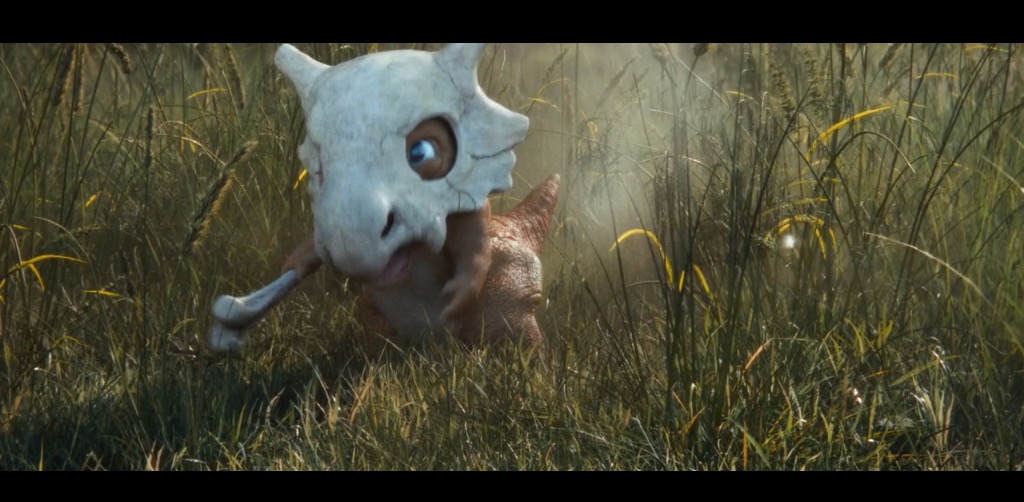
We then transition to a field in the countryside, and are introduced to Tim Goodman (Justice Smith) and his friend Jack (Karan Soni). Right away, the Pokémon in the movie definitely show that the film has made the visuals work in a real-world context. On top the Mewtwo rampage, the film uses 54 of the 809 (and counting!) Pokémon in some creative setups that put a unique spin on the long-running series while not forgetting what made it work to begin with. Anyway, Jack has brought Tim out to catch a Cubone; and while Tim is reluctant, he still decides to give it a go anyway. Before I continue, I will also note that the Poké Ball prop in this scene is actually a cell phone powerbank in that shape; with the LED lights on the button being replaced with one LED running down the stripe of the ball.

"It's Christmas sunshine, and I'm after someone on my Naughty List."


Tim takes the ball and starts talking to Cubone, and the way he mentions Cubone’s skull mask also foreshadows Tim’s own background. He throws the ball, and while it at first seems he’s caught Cubone; the ball not only pops back open, but Cubone throws its bone at Tim so hard that it doesn’t just knock him down, there’s actually a small explosion! After that, we find out that Tim is apparently an insurance salesman who just turned 21 years old; making him both older and already more expanded than in the game, where he’s 17 and essentially a cipher that players can apply traits to. Also, the game is basically a point-and-click adventure like the ones I used to play on PC: Maniac Mansion, Day of the Tentacle and my personal favorite; Full Throttle. The movie takes a different direction, but one that still fits. He then gets a signal on his phone, which he admits finally happened. Probably using Boost Mobile or something. He checks his voicemail, and finds out his something happened to his father Harry. 


Getting on the train from Leaventown (see what they did there?), he heads to Ryme City; and is greeted by a Lickitung licking him. He just takes this in stride as he dries himself off, and this is another moment that establishes the tone of the movie and how the Pokémon are used: rather than try to shy away from the absurdity, they embraced it while also making it work in the context of our world. A video then plays on the monitors of the train, which introduces Howard Clifford (Bill Nighy), a character unique to the movie who helped build Ryme City. There’s also a cameo from a Pokémon Trainer in a familiar looking outfit (Ryoma Takeuchi, “Kamen Rider Drive”). 


Despite having a degenerative illness that’s left him wheelchair-bound; his wealth and skills not only created a vast array of business deals, but also made Ryme City a place where people and Pokémon coexist peacefully rather than train, battle and rest in Poké Balls. I also kind of like how some of the footage in this video is made to look like it’s from the 1990s; with his hairstyle, the relative video quality and aspect ratio being made to match. 


Tim steps off the train in Tahnti Station, which is the London Underground being reworked with special effects to portray Ryme City. This shot of Tim walking to the Ryme City Police Department is a great example of the approach the filmmakers took to portray the Pokémon World: though CGI has reached a point where they can believably work on film, the movie actually was shot on 35mm film and mainly on location (London for the majority, with some scenes in Scotland and Colorado) and practical sets rather than relying on digital cameras and chroma key. This is similar to how films like Mad Max: Fury Road and these new Star Wars movies have been made, which I appreciate. On top of this, by downplaying reliance on battles; greater emphasis is placed on making the setting seem like a developed world rather than just another cliché “live-action cartoon” aesthetic countless other adaptations have done. So, seeing people accept a Snorlax sleeping on the road and Machamp acting as a crossing guard fits this world perfectly.


Entering RCPD HQ, Tim meets with Lt. Hide Yoshida (Ken Watanabe) about his father’s disappearance and apparent death. Yoshida also has a Snubbull, and I guess this was a natural progression for Watanabe among genre films: he’s helped train Batman, researched Godzilla and was a samurai Transformer that fit in a sports car; among other roles. On that note, he’s a composite of Detective Baker and Inspector Holiday from the game; filling the same role as Harry’s former colleague and Tim’s mentor/surrogate father in Ryme City. After the two talk about Harry and Tim being a former Pokémon Trainer, Yoshida gives him the key to Harry’s apartment. I definitely like this shot of Tim heading to the apartment building, and it’s full of great little details like a Joltik scurrying on a vent and a group of Aipom climbing on the sign to the apartment building (more on that in a moment). The movie is already establishing itself as a sort of blend of films like “Blade Runner” and “Who Framed Roger Rabbit,” and the title character still hasn’t appeared yet!

In the apartment building, Tim encounters a Psyduck while checking his father’s mail; and its partner; CNM intern Lucy Stevens (Kathryn Newton)! Oh boy, it’s the noir trifecta! The lead is new in town, his parents are dead; and the love interest just happens to be an intrepid reporter! On top of being like our April O’Neil, Lois Lane or Vicki Vale for this movie; she seems to be a composite of Emilia and Meiko from the game: combining the former’s spunk with the latter’s investigative reporting skills. Despite being relegated to writing online fluff pieces (I can relate), she definitely is a great help to Tim as the movie goes on. That’s also a nice outfit Tim is wearing: it would be a shame if something happened to it.

Tim goes into his father’s apartment, and shuts off the TV; which is playing the film within a film from “Home Alone,” “Angels with Filthy Souls.” “Keep the change, ya filthy animal!” I will also deal with the potential reboot as it comes, as well as a reversion as an offbeat adult comedy. 

We then get some flashbacks to when Tim was younger that expand on his past: He’s not only estranged from his father, but in a notable difference from the game; his mother apparently died of an unspecified illness when he was a child. Both of these caused him to turn his back on being a Pokémon Trainer; and he’s been living with his grandmother (Josette Simon) ever since. In the game, Tim’s mother isn’t seen; but is stated to be alive and well by his dialogues, providing moral support as he searches for his father Harry in Ryme City.

Searching through his father’s belongings, Tim finds a sample of R amid his case files; and ends up unwittingly poisoning the Aipom with it as he opens the window to air the place out after almost getting a whiff of it. While this is the only form of R from the game in the movie, it has the same effect of bringing out the more aggressive traits of a Pokémon and enhancing their powers. 

Tim then notices some rattling in the kitchen, and picks up a stapler to investigate the source. The tone of this movie is now firmly established at this point: at just about 20 minutes in, we’re introduced to the titular Detective Pikachu (voice of Ryan Reynolds)!

Oh Hello there!


As Tim is a bit uneasy at the fact there’s a Pikachu that can talk like a person, I must give some major props to the VFX artists: rather than turning Goombas into knockoff Stormtroopers, they nailed what worked about the original designs while also giving us something that can work on film. Definitely beats a bunch of juiced-up Ninja Turtles or Transformers that look like they came out of a junk pile.


While in the game, the worst thing the Aipom did was steal a piece of jewelry from someone; the Aipom here all attack Tim and Detective Pikachu like a group of crazed, purple-eyed zombies! One of them leaps on Tim’s head and others start climbing on his body, causing Detective Pikachu to look for something to throw at them! Maybe the cream cheese spreader could work. The two are chased on the roof, with Tim being briefly pulled out of his shoes; dress shirt and pants, almost saying "oh shit" before it’s cut off by the crazed Aipom and they escape through the garbage chute! The way Smith is exclaiming as it happens kind of reminds me of Cleveland and the bathtub.


Running into an adjacent alley, while this bit of Tim running around half-dressed is clearly for younger viewers; I’m honestly more amused at the fact that nobody seems to react to Tim yelling about what’s happening. They only really address Tim when he calls attention to Detective Pikachu, and the latter lampshades this as Tim reclaims his pants from the Aipom: “I figured you’d be more of a briefs guy, I don’t really wear underwear; I’m not modest.”

"This guy has the right idea : He wore the brown pants!"

Said alley also has a Charmander and an Octillery grilling at a hibachi, and on top of Tim being the only one who can understand Detective Pikachu (everyone else hears the voice of the anime VA, Ikue Ohtani); he warns Tim that people might get suspicious about him mentioning “the stuff he put up his nose.”  R: it's a Hell of a drug.

Noticing Harry’s name and address written in the tag of Pikachu’s hunting cap, the two regroup over coffee at the nearby Hi-Hat Café, a location from the game I’m pleased made it in.


I also like the little touches of Detective Pikachu’s love of coffee; and the inclusion of Pablo (Alejandro de Mesa in a bit part) and Ludicolo acting as a barista. 


There’s also a brief cameo from Jigglypuff (voice of an uncredited Rachael Lillis), and I also like this part of the Purrloin and its partner; reminds me of the part with Gaff in the noodle shop in Blade Runner.


So, there’s the story: while it does take come creative liberties with the game, the basic plot thankfully remains the same: Tim is a young man who has come to Ryme City to search for his father Harry; who went missing, presumed dead two months prior to the film’s events. Teaming up with Detective Pikachu, the two form an unlikely bond to figure out the truth about what happened and uncover a greater mystery that could threaten the entire Pokémon World. I actually am glad they started with this one first, since it’s logistically easier than trying to condense over 20 years of video game lore and over 1,000 episodes of TV into one 104-minute movie. 


Back at the apartment, Tim and Detective Pikachu get cleaned up and try to determine their next move. I also like how actual character posters and TCG cards are used as props in Tim’s childhood bedroom. He tries to claim they were set up for visits by Harry, but Detective Pikachu naturally isn’t fooled. 

The next day, after Tim puts on an outfit that his father left for him (including an Unown shirt that I have the official replica of); he and Detective Pikachu try to determine what happened with the R and Harry’s investigation. Before the two leave to start asking around for Harry’s informant; the movie even spoofs the cliché of the “Wall of craziness” made of potential clues. Reminds me of trying to find Pepé Silvia.

After Detective Pikachu describes the situation as “caliente fiesta,” he and Tim decide to go “press” Lucy for what she knows at CNM. Um, phrasing?


At CNM, a news broadcast announcing the Pokémon Carnival is underway with Howard Clifford and his son Roger (Chris Geere); with an instrumental of the Pokémon Theme playing in the BGM. While their working relationship isn’t too bad, their relationship as father and son is strained. Roger sees his father’s work with Pokémon to help his condition as overly frivolous, Howard is just as put off by his son’s cynicism. It kind of reminds me of the relationship between Norman and Harry Osborne in most versions of Spider-Man. 


On that note, while Geere somewhat resembles Roger’s appearance in the game; his character is much more condescending, inheriting some traits from rival detective Brad. I can at least tell that Geere is enjoying himself: I never watched that show he was on, but he’s making a meal of the scenery as a sort of parody of these pompous TV personae. Case in point: when Lucy comes over with a tip about the incident at PCL Labs, Roger dismisses the idea; telling her to find a source and commenting that “it isn’t news if it can’t be verified.” That’s more commentary on journalism ethics than I expected from this movie, to be honest. Again, I can relate.


Tim then meets with Lucy about the information, and while it’s not exactly the same way it played out in the game; the TV station fulfills a similar role in providing vital information about the case. In some ways, it kind of reminds me of the dynamic in Venom: young investigators good, older corrupt corporate executive bad. Lucy presents Tim with more samples of R, and tells him that Harry’s informant is at the docks; warning him that “they’re pretty dangerous at night.” Tim replies that he’s “pretty good at being alone at night.” Hey! Phrasing!

Detective Pikachu also lampshades how awkward that sounded, and I gotta say; I’m surprised at how naturally the cast plays off each other. Not only do the human actors fit surprisingly well for the setting and tone, the way the Pokémon occupy Ryme City is seamless. This is vitally important when they’re the emotional center of your story, least of all; the title character. On that note, he and Tim head to the docks; and discover that Mr. Mime is Harry’s informant, crashing as he tries to get away on an invisible bicycle. “Mr. Mime! This isn’t the time to use that!”

This scene is notable for several reasons: not only is Mr. Mime much more savage without saying a single word than in previous versions (such as the main games or “Mimey” from the anime), but its tone was influenced by; of all films, David Fincher’s thriller “Se7en.” Moreover, while the studio wanted this scene cut initially; director Rob Letterman was able to convince Tsunekazu Ishihara himself (president of The Pokémon Company and a key figure to the series since the beginning) to keep it in. Sure enough, it’s one of the most memorable parts of the movie. Tim actually starts pantomiming matches and gasoline to try and find out where the R is being moved; and I am very impressed with how expressive he and all the other Pokémon are in this movie.


"I'm about to do to you what Limp Bizkit did to music in the late '90s!"


Eventually, Mr. Mime does get spooked enough by his interrogation to reveal where one of the shipments of R was sent; and Detective Pikachu also lampshades that the location is “not from the games.” Even with the track record live-action video game and anime adaptations have had; I’m ok with changing things if the changes make sense for the different medium. I’ve beaten the game at least twice (planning a third playthrough before the sequel on Nintendo Switch), and I’ve taken many hours depending on how much I want to spend finding all the secrets and unique cutscenes.

The location is an underground battle arena known as “the Roundhouse.” How does this club introduce you to its approach to Pokémon battling in the seedy underbelly of Ryme City? Two words: beatboxing Loudred. 

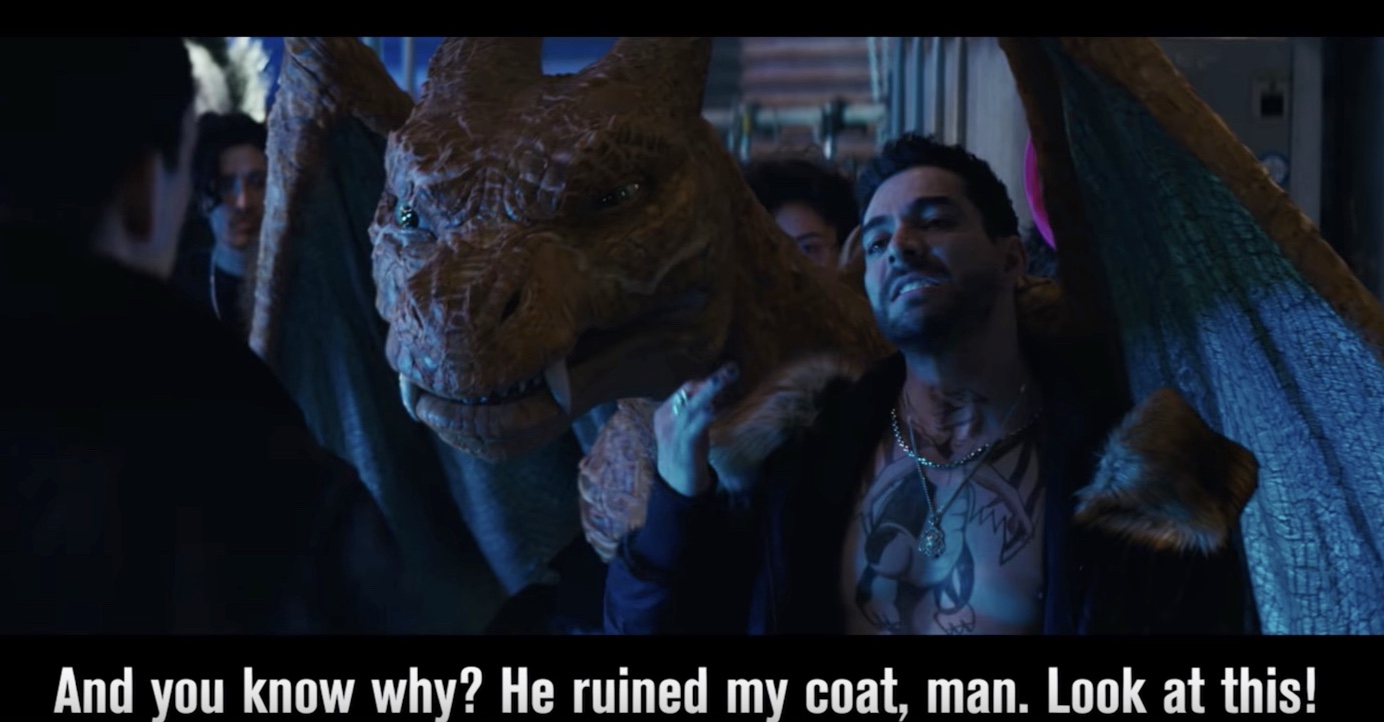
I mean, when I heard this movie was going to render its Pokémon in realistic CGI; I was expecting something like how they look in “Super Smash Bros.” or “Pokkén Tournament,” but they went all out with it. There’s also a small appearance from Diplo as a DJ/fight MC. I don’t listen to him, but I imagine this will be remembered in 20 years the same way the campy OST from the first movie is now. Their investigation draws the attention of the arena’s head, Sebastian (Omar Chaparro); who has had a run in with Detective Pikachu before, along with his Charizard.

"Nice to see you, Jared! I'll take a footlong: fully loaded."


The investigation also draws the attention of a mysterious woman with pink hair named Ms. Norman (Suki Waterhouse in a non-speaking role). Sebastian shows how the last time Detective Pikachu was there, the encounter damaged his coat and scarred his Charizard! While some people were put off by how Charizard was rendered in this movie; it’s actually not that different from how other live-action fantasy works like Harry Potter or Lord of the Rings have rendered their dragons and other creatures. Personally, I think it actually looks pretty badass.


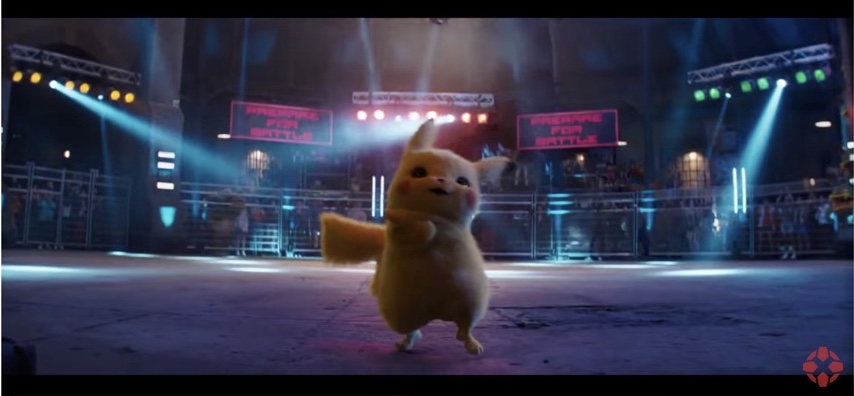
Now, comes what’s probably my favorite part of this movie: the Roundhouse fight. Sebastian says that he will tell Tim what he knows about the R and what happened to Harry on the condition that Pikachu wins a rematch with his Charizard. He grudgingly agrees, and Detective Pikachu hands Tim his hat for safekeeping. “Big CGI fight coming up!” 


Courtesy: IGN


As the doors to the ring are locked, Sebastian doses his Charizard with a year’s worth of R; as Pikachu realizes this won’t be as easy as before! While Tim does give recommendations from his move pool, Pikachu replies that due to his accident with Harry; not only does he not remember his past, he doesn’t remember his attacks either! This is similar to how it was in the game, but the movie plays with it in ways that honestly made it one of the most fun experiences I’ve had in the theater this year. As Pikachu realizes the danger at hand, he shouts at Tim, and I quote: “GET ME THE HELL OUT OF HERE!” … Guess that’s expected when you cast the same guy as Deadpool in the title role. I actually don’t mind it within reason, and it kind of reminds me of the 1986 Transformers movie and the 1990 TMNT movie in that context.


What follows is actually a creative way of handling Pokémon battles in live-action: the way both Pikachu and Tim rely on both their wit and their other skills to win actually does a good job of putting its own spin on both the 3DS game and the series as a whole. The way the fight is staged is like a mix of the Rancor scene in Return of the Jedi; the Bonesaw fight in the first Spider-Man and the Hulk VS Thor fight in Thor Ragnarok.

I must also compliment the crew that everyone put together to help make this movie: the production designer Nigel Phelps (“Wizarding World of Harry Potter”), award-nominated cinematographer John Mathieson (“Logan”, “Gladiator”) and the two editors of James Thomas and Mark Sanger. With these and other crew members’ credentials, that alone tells me they weren’t just looking for who they could get: they were looking for someone who they knew was good to get this on the screen. The music by Henry Jackman (whose credits include both “Wreck-it Ralph” films, both “Kingsman” films and the second and third “Captain America” movies) also does a great job at blending the series’ sounds of orchestral music, electronic music and driving rock. Case in point: when Tim starts trying to stomp out the flame on Charizard’s tail; the beatboxing Loudred I mentioned before start going nuts when the other vials of R in Sebastian’s coat are broken and Sebastian starts yelling like a screaming banshee! Again, I’m not familiar with Omar Chaparro; but he must have known full well what kind of movie he signed up for when he did that.

As the arena starts turning even more into a madhouse than before, Tim; as the victor, is able to get the location of the R’s source: a doctor at PCL Labs will know more, but there’s still the matter of the rampaging Charizard juiced up on R! The noise from the Loudred and all the other Pokémon rampaging broke an aquarium with a Magikarp, which is able to evolve into a Gyarados through sheer will! I am very impressed with how expressive the CGI Pokémon are in this movie. The moment Charizard starts sobering up from the R is also the exact moment it knows it’s lost the battle; as if to say, “Oh man: this is gonna hurt!”

After a misunderstanding with the RCPD, Yoshida shows Tim the security footage of the crash before Harry disappeared. He also tries to talk Tim through his grief, but Tim will have none of it. After that; Tim realizes that in order to really get closure on what happened to Harry, he and Detective Pikachu need each other. Even in moments of this movie where I’m not laughing (which are rare), I’m invested in other ways of how they made this story work. As the two vow to solve this mystery; I am impressed at how much emotional weight they’ve given to an electric mouse and a supporting cast member from Jurassic World: Fallen Kingdom.


Then, the two are accosted by Ms. Norman; whose black SUV is immediately referred to as a “Bad Guy Car” by Detective Pikachu. Of course: He’d definitely be savvy enough to know that. On top of being voiced by the same actor as Deadpool (putting a family-friendly spin on the role in the process), the script definitely does a good job at poking fun at the conventions of the genre even if you’re not familiar with noir detective stories. 

"Have fun at your midnight showing of Blade II."

Ms. Norman is an aide to the Cliffords at CNM, leading Tim and Detective Pikachu to Howard’s office. Among the sights here are an array of evolutionary stones, and some statues of Dialga, Palkia and Arceus. Insert “Sinnoh Confirmed” joke/reference here. I must once again compliment how the VFX artists really did a great job with this movie. The way this Eevee touches the Fire Stone and transforms into a Flareon while cloaked in a bright light is right on the mark.


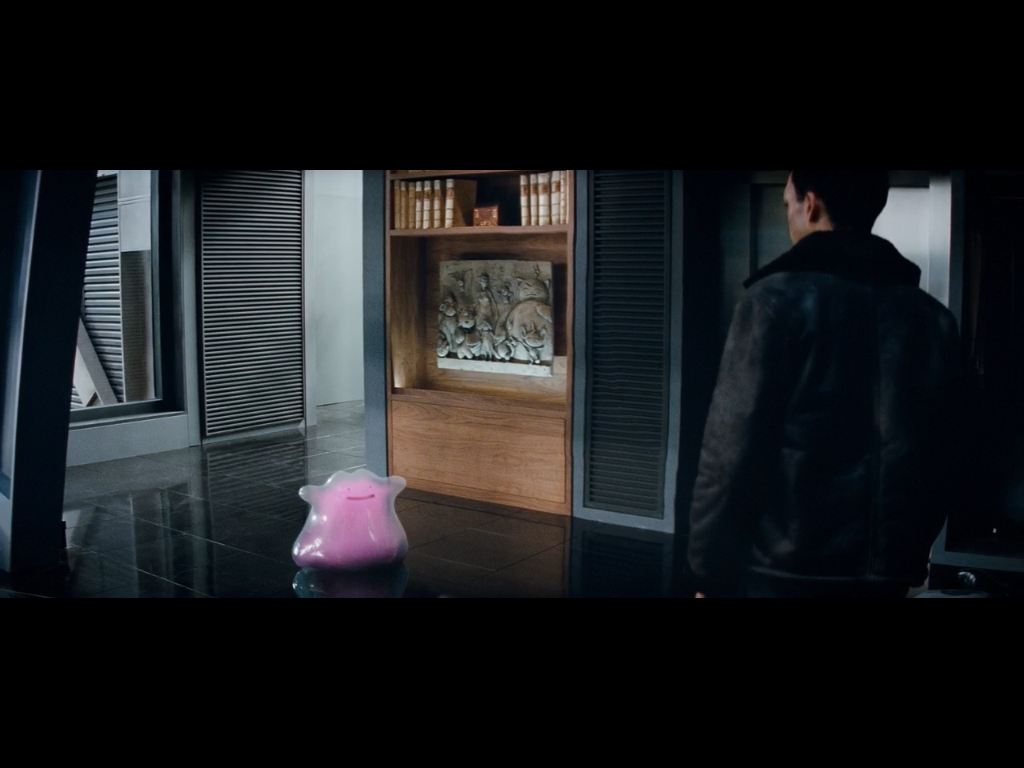
On that note, Bill Nighy’s performance in this movie has a different approach to Howard’s character than Geere’s does for Roger. Even in a movie full of interactive holographs and shapeshifting Ditto (that last one will be important later, by the way), he reads his lines in a surprisingly dramatic and serious fashion; like any professional would. Though this scene does foreshadow his true intentions later on, he is committed to his craft as Howard tells Tim that Harry was trying to solve a mystery for him! Detective Pikachu lampshades this, remarking “that’s a twist, that’s very twisty.”


(Gasps) "Fourth wall break inside a fourth wall break!"
Howard then shows Tim and Detective Pikachu a hologram of the crash footage; which reveals more details that help the case. On top of a brief glimpse of Harry, we get the reason why Detective Pikachu has no memory of what happened: his mind was wiped by Mewtwo (voices of Rina Hoshino and Kotaro Watanabe)! I definitely like this approach: in a similar manner to the game, the mystery slowly unveils more of what happened while also unraveling the larger mystery at hand. Definitely makes more sense than how Alita adapted its story.


After entrusting Tim and Detective Pikachu to find out what happened, the two meet back up with Lucy at the Hi-Hat Café. Since Roger snubbed Lucy’s tip earlier, she decides to give the information to Tim and Detective Pikachu instead. This ends up corroborating the incident at PCL Labs, and all of them decide to go check out the laboratory in the mountains the next day! As many others have been, I am very amused by this whole scene of Detective Pikachu riding in a booster seat in Lucy’s car; as well as the foot massage and spa music to prevent an explosive headache from Psyduck.


"Mm, rich Corinthian leather!"


Breaking into the laboratory, as it’s been condemned; it’s revealed the real reason why Roger dismissed Lucy’s story idea: he was actually one of the financiers responsible for the creation of the R and the capture of Mewtwo! So, the next key to what happened is to find out what Clifford covered up at the lab! Another key figure in the incident is Dr. Ann Laurent (singer/actress Rita Ora in a bit part), who was part of the experiments the night of the accident! 

As they discover some Greninja and Torterra that were part of the experiments, Lucy starts getting some pictures of the lab while Tim and Detective Pikachu scope out the site of the breakout. Outside, what appears to be Roger uses some controls in his briefcase to “tie up some loose ends” while Tim and Detective Pikachu start probing what’s left of the computer at Dr. Laurent’s workstation to find out the exact details of the incident. One brief thing before I continue: I definitely like the little details of Psyduck’s pupils dilating and the Greninja emerging from their stasis pods right as the doors open. The way this scene is filmed and how the sound is cued creates the ideal mood for what comes next.

While some of the files are corrupted, enough of them are intact to confirm the information about Dr. Laurent’s experiments; and reveal another one about a device for a neural link! Why, it’s the new Nintendo Brain Switch! On top of other properties, it allows you to immerse yourself in your favorite games by plugging directly into the base of your spine!


All joking aside, Tim and Detective Pikachu continue searching for more information about the incident two months before Mewtwo’s escape. The latter is able to find Dr. Laurent’s video diaries from the beginning, which explicitly state that it’s the Mewtwo that escaped from Kanto nearly 20 years ago! There are many parallels with the first movie, and this is one of the more notable ones. The creators have even expressed interest in doing a full live-action Mewtwo Strikes Back adaptation, which I’m actually intrigued to see them try.


Now, Tim and Lucy need to get back to Ryme City and let everyone know what’s going on; but first they need to escape from the lab! What follows is another great action scene centered around the Greninja and Torterra; both species that suit this sequence alarmingly well! Not only do the designs look great on film, I actually like how the scene alludes to the monsters doing the more absurd things they’re described as doing in the Pokédex: not just with Greninja’s Water Shuriken being able to shatter glass; but Psyduck’s explosive headaches steal the show. 

The effects of the experiments on the Torterra also start to take hold, making them into massive beasts the size of mountains! … I must say, on top of being a good template for a big-budget Gamera reboot; this does make me want to play Golden Axe again for the umpteenth time.

Everyone starts climbing and jumping around as the landscape starts shifting around them! Detective Pikachu even quips, “At this point: How could you not believe in climate change?!” You and me both, Detective Pikachu: it’s basically the same as not believing in oxygen at this point. They’re able to clear the gap back to the city, but Pikachu is then injured in a rock slide! He’s this close to meeting his maker, but some Bulbasaur are able to lead everyone to the Forest of Healing! As they march in the view of some Comfey and Morelull floating in the background, I can officially say that this movie has had some of the biggest VFX breakthroughs since Jurassic Park. Naturally, this inspired some image macros even before the film came out.


The sound design in this movie is also something I’ve been meaning to compliment: on top of Reynolds’ performance, while some Pokémon say their names like on the TV show; others have arrangements of their cries from the games. I think that’s actually a pretty good compromise. Mewtwo then heals Pikachu’s wounds as well as restores his memory right before Mewtwo is captured by the true villains of the movie! Not only did Pikachu help Mewtwo escape, but the two of them realize they need to split up in order to stop them! 


This final act at the Pokémon Carnival’s parade has the same general idea as the final chapter of the game, but takes a different direction to make it work for the movie’s story: while Pikachu takes the long way back, Tim rides back with Lucy and Psyduck to let everyone know what’s going on! While in the game, there were only a few areas and a clock tower to search for clues; the movie makes use of nearly the whole city. Artistically, it blends the European architecture of the London filming location and a sort of neon-lit “Far East” aesthetic in the vein of Gotham City in Batman Forever; in a good way. 


While Tim goes to warn Howard about what’s going on, Lucy decides to alert the public while slipping into the coat of fellow CNM reporter Cynthia McMaster (an uncredited Abbie Murphy); and Pikachu is singing a somber; yet strangely humorous rendition of the Pokémon Theme.

"Rock, meet bottom."


Making his way back to Ryme City, Pikachu finds the crash site; and what’s left of the Water Shuriken that Greninja launched! This also confirms that the opening car crash wasn’t an accident: it was an assassination attempt! While in the game it just cut to black and hinted at that idea; that’s surprisingly dark. Not quite as dark as the “December 16, 1991” plot thread in Captain America Civil War; but it fits what they’re going for. Also, I kind of like how it’s a subtle nod to Greninja’s initial reveal in Super Smash Bros. 3DS/Wii U. Pikachu realizes what Mewtwo was actually trying to do, and that Tim is in danger! Back in Ryme City, Tim has also learned the sickening truth; and decides to confront Howard. However, Howard anticipated this; and already has the neural link on!


How do you like it? It's the new Nintendo Brain Switch: care to try it when I'm done, Tim?

Dosing Mewtwo with copious amounts of R, Howard transfers his mind into Mewtwo’s body! On top of Mewtwo’s height from the Pokédex of 6’7” being accurate (using Tim as a yardstick), this whole final battle is going to be insane; much like Howard has become. I love it and this movie for that. He is the true villain of the movie, playing all the angles and using his condition as a front for his real plan: to fuse everyone with the bodies of Pokémon! … I’ve never given much thought to it before, but my Pokésona would probably be of my favorite, Lucario. 


Trapping Tim in his office, Howard uses Mewtwo and a bunch of R hidden in the parade balloons to set his plan in motion! For all the weirdness people accept with the Pokémon, they do at least notice when Mewtwo starts causing havoc at the Pokémon Carnival; making all the Pokémon and their partners “merge to one!” 


Pikachu reaches the city just as everything starts going crazy, remarking dryly that “this really blows his bridge discovery out of the water.” Climbing on top of the balloons, he engages his newly-restored powers, shouting: “Game on!”


He then starts bouncing on top of the balloons and off other flying Pokémon, jumping and weaving through Mewtwo’s attacks! This does remind me a lot of the Poké Floats stage in Super Smash Bros. Melee, hopefully it comes back as DLC for Ultimate: still working on the new stage creator feature.


As Pikachu engages Mewtwo, Tim is freed from his bonds and notices some banging inside a nearby cabinet. He opens it to find Roger, the villain of the game and supposed secondary villain of this film bound and gagged! His role and form have been assumed by Ms. Norman, who is actually his Ditto that’s turned on him! While Ditto’s eyes are slightly obvious CGI, the way they stay the same in each form it shapeshifts into is a nice little nod to how its face doesn’t change in some other versions of the series.


While the battle rages, Tim realizes he needs to remove Howard’s neural link to Mewtwo as he and Roger clash with Ditto; who has been enhanced by Howard’s experiments! Pikachu also continues clashing with Mewtwo outside, putting up an impressive fight against this fearsome genetic experiment! Not bad for adapting a battle that was basically a quicktime event sequence in the game. 

Though Pikachu is nearly downed by the recoil from its Volt Tackle, he tells Mewtwo that he wasn’t trying to win: he was just trying to distract Howard! Yes folks, much like how Judge Doom was done in by his own “dip,” Ditto and Howard end up getting bested by their own R: the two are dosed with so much that it destabilizes Ditto and allows Tim to remove Howard’s neural link to Mewtwo!


Tim Goodman wins! FATALITY!


Mewtwo is able to save Pikachu from falling, and as Howard is taken away by the authorities (presumably to the ward or at the very least a “white-collar resort prison”); Roger sheepishly gives Lucy his father’s position, and agrees to undo the damage his father has wrought. Likewise, Mewtwo has been convinced of the value of human life by Pikachu; and to make up for previous slights, Mewtwo declares “I will undo what has been done.” That does make me wonder what they’ve got in mind for the planned sequels and spinoffs, and I will explain more in a moment.


We close on what’s arguably the biggest difference from the game: while the end of that does reveal that Harry is still alive, there aren’t any specifics beyond invoking “and the adventure continues” (looking forward to the sequel on the Nintendo Switch). Here, Harry reunites with his son Tim; and the two are at last together! He’s even played by none other than Ryan Reynolds himself!


"Go be a role model for someone, and tell Beast to stop shitting on my lawn!"

I do like how the movie has the foresight to be self-contained like this. The credits roll to a really good arrangement of the original “Pokémon I Choose You” music, and the art is even drawn by Ken Sugimori in his style! Even the credits are as interesting to watch as the movie itself. As for the songs “Carry On” by Rita Ora and “Electricity”: again, I think they’ll be remembered the same way as the first movie’s OST in another 20 years.


Well, these reviews were definitely interesting experiments; and it's the most fun I've had writing in a long time. This also marks my 500th post on this blog, and though I'm still mostly retired; I might post something when I want, but I better wrap this up.

It took 26 years for them to make a good live-action movie about a beloved anime and video game franchise; and even with my lofty expectations as a longtime fan, “Pokémon Detective Pikachu” is a great first live-action entry for the franchise. Whether or not the proposed sequels and spinoffs (the first of which is currently in development from the writers of “22 Jump Street”) use existing material or write new stories, I welcome the idea.

As I pointed out before, it took years if not decades of sifting through lousy movies based on American superhero comic books till we got ones that were good consistently; and I am definitely open to the idea of adapting the main games and anime along these lines. With a proposed live-action Red and Blue adaptation and Mewtwo Strikes Back remake, hopefully they’ll make it work: my ideal pitch for a film set in the Kanto era would be “Stand By Me” meets “Star Wars: A New Hope,” by way of “Raiders of the Lost Ark” and the Marvel Cinematic Universe. I also wouldn’t mind a similar visual style to this film, and to embrace the insanity of the plot and “colorblind casting” for the human characters. One last thing: drop the “Red and Blue,” just call the standalone adaptation “Pokémon.” One word is much easier to fit the title on a theater marquee; store shelf or digital streaming list. That will be all for now. Later.